Chart levels
The problem with a level that moves
· 4 min read
A horizontal level is a number. 1.0850 is 1.0850 on Monday and it's still 1.0850 on Friday. Every charting platform in existence can watch a number for you, and most of them have been able to since long before any of us started trading.
A trendline is not a number. It's a number that changes every bar. The line you drew across two swing lows sits at 1.0850 this morning, 1.0861 tomorrow morning, 1.0894 next week — and the thing you were actually waiting for moved with it, quietly, while you were asleep.
That's the whole difficulty, and it's why alerts on horizontal lines are everywhere and alerts on diagonal lines are rare.
Neither line is the better one — they answer different questions. A horizontal level is a memory: this price mattered before, and a number is exactly the right way to hold a memory. A trendline is a different kind of statement, and a number holds it badly. Most working charts carry both, and the trouble only starts when one is asked to do the other's job.
Why the tools stop at horizontal
An alert on a fixed price is a stored number and a comparison. Price came in, compare, done. It costs almost nothing, and it stays correct forever without anyone touching it.
An alert on a trendline can't store a number, because there isn't one. It has to store two points in time and price, and then compute the line's value at this moment, on every incoming tick, before it can compare anything. The level being watched is a function of the clock.
That's not difficult mathematics. It's just a different shape of problem than the one most alert systems were built around, and a lot of platforms never went back to redo it.
What traders do instead
Three workarounds, and each one trades something away:
- Re-drag a horizontal alert every session. It works, and it's the most common. But it's manual, it's easy to forget, and the error grows with every hour you're away from the chart.
- Set the alert at a round number somewhere near the line. Faster, but you've quietly changed what you were waiting for. You're now watching 1.0850 instead of the line, and by Thursday those are different places.
- Watch the screen. Which works right up until the hour you can't.
The drift is easy to underestimate
Take a line rising about 4 pips an hour — a very ordinary slope on an H1 chart. You set a static alert at the line's value before bed. Eight hours later the line has moved 32 pips above where your alert is sitting. The alert fires. The line is nowhere near.
Or the line falls, and the alert never fires at all, because price met the line 32 pips above a number that is no longer relevant to anything.
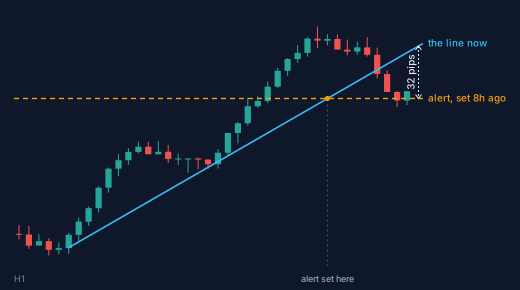
Neither outcome is a bug in the alert. The alert did exactly what it was asked. It was asked the wrong question, because the question changed overnight and nobody was there to update it.
The line carries a rate, not a price
This is the part that gets lost. A trendline is a claim about speed — that the market has been making higher lows at roughly this pace, and that the pace matters. The price it happens to sit at today is a consequence of that claim, not the claim itself.
The moment you replace the line with a fixed number, you throw away the rate and keep only a snapshot of it. The number is the least interesting thing the line was telling you.
Two honest caveats
A trendline is subjective in a way a horizontal level isn't. Two traders looking at the same three swing lows will draw three different lines, and both will be sure. A moving level is only ever as good as the two points it was built from, and those points were chosen by a human with an opinion.
And a slope makes a touch narrower. A steep line meeting a fast market gives you a shorter window than a flat level does — the geometry is against you, and how tightly you want to define "touched" matters more than it would on a horizontal line.
None of that makes the line worse than a number. It makes it a different tool, with the cost sitting in a different place.
A level that moves is still a level. It just can't be written down.
This article describes how horizontal and diagonal levels differ as tools. It is not trading advice.
Batdorj Byambadorj
Batdorj Byambadorj writes from nearly twenty years of trading forex.